Here are a few tips and things to look out for, for owners and for owner trimmers.
Thrush
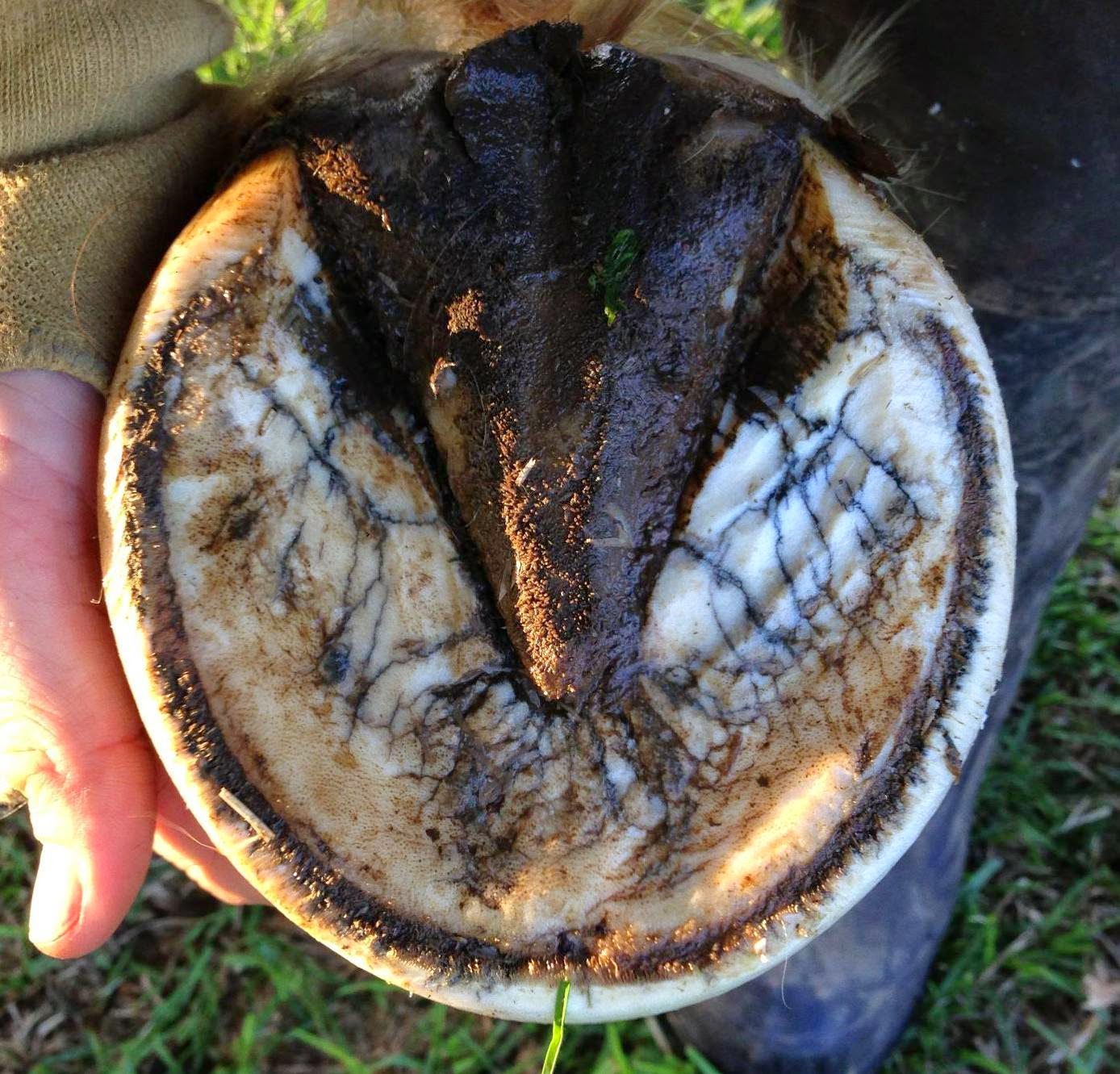 |
| An otherwise healthy hoof that has a thrush infection taking hold in the collateral grooves and all across the sole and laminar line. |
Thrush is the #1 issue that hooves deal with in the wet. Thrush is a general term for anaerobic organisms that thrive in a wet smelly hoof. It is that stinky, black paste you can get on the tip of your hoof pick. Healthy hooves don't smell! If your horse's feet smell, it is probably thrush.
It eats away at hoof tissue - mainly in the frog and the collateral grooves (beside the frogs). Some horses can present with significant lameness due to an active thrush infection - some horses will loose their healthy heel first landing because the thrush infection makes the back of the hoof tender. Thrush infections can lead to abcesses and seedy toe/white line disease. If left, it can even eat away at the sole, causing a thin sore sole that can't protect the pedal bone.
The best way to deal with thrush is to be vigilant in wet weather with thrush prevention. This mainly includes topical treatment with a substance that somehow makes the environmental conditions in the hoof not ideal for thrush growth. I recommend spraying apple cider vinegar (just the supermarket stuff, not the expensive supplmenent stuff from the feed store, although this works too!) onto a clean picked hoof every day when it is wet. Make sure your horse has somewhere dry to stand, at least some of the time. This could be a shelter with sand, or a high spot with good drainage, turnout in a dry indoor arena, or even a stable with dry bedding where they can spend a few hours to dry out their feet. Giving the hooves a chance to dry out can often be the only way to help prevent thrush.
Once thrush takes hold though, I have noticed (in Sydney, at least) that ACV just doesn't do the trick to treat a thrush infection that is already established. My clients have had success with straight iodine sprayed &/or scrubbed onto the frog and collateral grooves every 2-3 days, along with picking the hooves daily to keep them free from the (normally helpful) dirt plug and having that dry spot to stand. Remember, thrush is anaerobic, which means it thrives in low oxygen. That is why it seems to take hold in deep crevices in the frog.
There are other products out there that I have seen work with varying amount of success - but the common factor in successful treatment doesn't seem to be what you treat with, but more how often the treatment is administered. Keep treating until there is no sign of thrush left - then start with preventative treatment if weather conditions still haven't dried up.
For trimmers, ensure there are no tags or flaps of frog that the organisms can hide under. I advocate minimal frog trimming except in cases where thrush may be an issue. Just open it up enough that the thrush cannot hide and you can treat it with ACV or iodine or your topical of choice. Sometimes you may find little pockets of thrush starting to eat away - or even find that your whole frog is about to peel off! Use your judgement - mostly with my clients I will leave as much frog as possible and advise treatment, and will return to trim again within a week or two.
 |
| Don't freak out if you see this! Just be aware that you need to treat it and provide hoof protection while the new frog toughens up. |
 |
| Here is my own horse Allie - see the minimal trimming of the frog to open up the thrush infection? |
Seedy Toe
.jpg) |
| A resection is a job for a proffesional - if you are an owner trimmer, get your mentor in to do this for you! |
Seedy Toe or White Line Disease is where thrush or other bugs invade the tissues in the inner wall. It can spread all over the hoof, all the way to the coronet. Seedy toe can lead to serious abscessing that may even lead to pedal bone infection if left unchecked. It is a serious case that needs a professional in when it requires resection, but during your maintenance trims you can keep an eye out for signs of it starting and nip it in the bud before it becomes a problem. If, while trimming, you see small (or even large) black lines that cross the laminae line, take your knife and nick them out.
 |
| Click to embiggen - see the line there circled in red? This is what seedy toe can look like at the beginning. |
If you have someone else trim your horse and they perform a resection, don't panic! It can look fairly invasive but it isn't. A resection allows treatment - ask your trimmer for specific instructions and follow them exactly. Your horse shouldn't need to have their workload altered unless there is a significant resection required. I have performed many many resections like the one shown above, and have not had one horse go sore because of it. There is a minor chance of a stick becoming lodged in the hole, but other than that it is life as per normal for the horse and yourself. As it grows out, just keep it dry and treated!
Abscessing
It is quite common for a horse to come up lame in wet weather due to an abscess. I hope you can see why after reading the above - your horse shouldn't abscess if he has been on a nice short trim cycle for some time and you are doing your thrush prevention.
If your horse is presenting as lame, and you suspect an abcess, I recommend calling in a vet to diagnose the abscess first and foremost. Your vet may use hoof testers to pinpoint the seat of infection. Some horses will not put their hoof on the ground if they have an abcess - but this is also a symptom of a broken bone. You need to rule out something more insidious first before you treat for an abscess.
For most cases, an abscess is a "wait it out" deal. You can poultice and your trimmer or vet may want to have a little dig with a hoof knife to try to relieve the pressure if the abscess is close to the surface, but most of the time the abscess needs to work its way out via the path of least resistance. Normally they burst at the coronet or the heel bulbs.
It can be very distressing watching your horse deal with an abscess - the pressure in the hoof can feel like when you slam your thumb in a door - very painful! Bute often slows down the proccess - being an anti-immflammatory. Give your horse somewhere comfortable to stand and lay down. Obviously, don't work him. You can poultice and use a therapy boot if you wish to speed up the process. Most of all, once the abscess blows, ensure you keep the area clean and free of thrush.
If after 2-3 days the abscess doesn't resolve, consult your vet.
Other Tips
During wet weather, your horse may have soles that are soft or even washed out and thinner than usual. You cannot expect your horse to have a level of soundness on par with dry times. Cut him some slack - if you are going riding on rough or rocky ground that he is normally ok with, take boots with you and put them on if he feels less forward than normal. Ride him on the verge where there is a little grass. Ensure you don't compromise that heel first landing. A horse landing toe first because of sore feet is doing damage to the navicular area.
Keep up the preventative treatments. A little bit of effort now will save you more effort and heartache later on down the track!
Shorten his trim cycle but take less off - leave a couple of mm of hoof wall above his sole for protection and grip in the wet. Check the weather over the next week before you trim - if it looks like periods of rain, give him a wet weather trim. If it is going to be dry, trim him for hard ground. You can always take more off if the rain doesn't eventuate, but it is very difficult to put some wall back on if he needs it in the wet!
Beware the flush of grass after spring or summer rains! This is a laminitis risk for horses that are prone. If you have a horse with a known issue, keep him off the grass!
I hope you have found this information useful. If you have any tips to add, please leave a comment below.


