Pages

Sunday, December 7, 2014

Wet Weather Hoof Care

Hooves didn't evolve to thrive in wet, squishy, muddy footing. Hooves can certainly adapt but you cannot expect peak performance during times when there is excessive rain. Hoof management becomes even more imperative during wet weather.

Here are a few tips and things to look out for, for owners and for owner trimmers.

Thrush
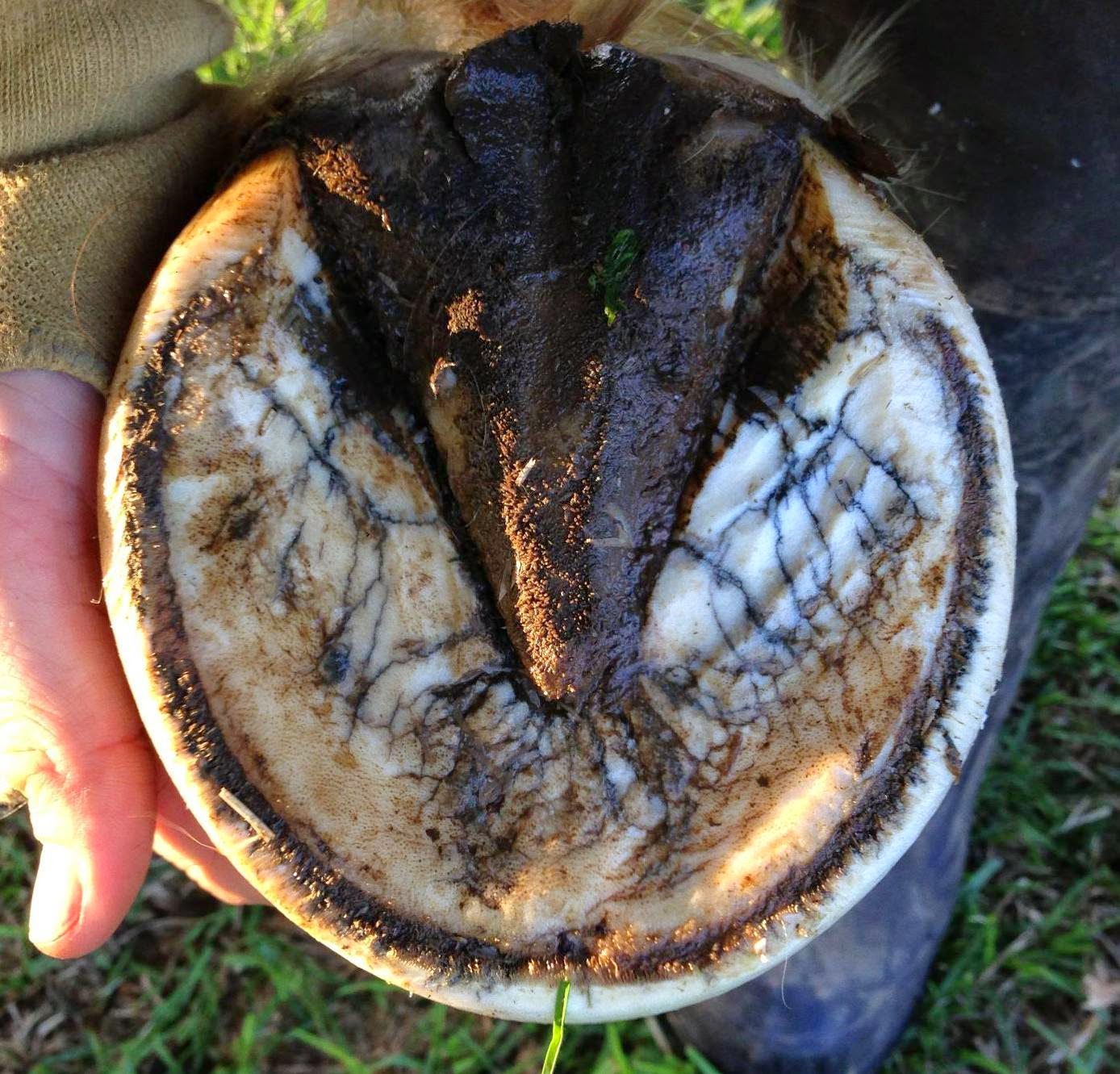

An otherwise healthy hoof that has a thrush infection taking hold in the collateral grooves and all across the sole and laminar line.

Thrush is the #1 issue that hooves deal with in the wet. Thrush is a general term for anaerobic organisms that thrive in a wet smelly hoof. It is that stinky, black paste you can get on the tip of your hoof pick. Healthy hooves don't smell! If your horse's feet smell, it is probably thrush.

It eats away at hoof tissue - mainly in the frog and the collateral grooves (beside the frogs). Some horses can present with significant lameness due to an active thrush infection - some horses will loose their healthy heel first landing because the thrush infection makes the back of the hoof tender. Thrush infections can lead to abcesses and seedy toe/white line disease. If left, it can even eat away at the sole, causing a thin sore sole that can't protect the pedal bone.

The best way to deal with thrush is to be vigilant in wet weather with thrush prevention. This mainly includes topical treatment with a substance that somehow makes the environmental conditions in the hoof not ideal for thrush growth. I recommend spraying apple cider vinegar (just the supermarket stuff, not the expensive supplmenent stuff from the feed store, although this works too!) onto a clean picked hoof every day when it is wet. Make sure your horse has somewhere dry to stand, at least some of the time. This could be a shelter with sand, or a high spot with good drainage, turnout in a dry indoor arena, or even a stable with dry bedding where they can spend a few hours to dry out their feet. Giving the hooves a chance to dry out can often be the only way to help prevent thrush.

Once thrush takes hold though, I have noticed (in Sydney, at least) that ACV just doesn't do the trick to treat a thrush infection that is already established. My clients have had success with straight iodine sprayed &/or scrubbed onto the frog and collateral grooves every 2-3 days, along with picking the hooves daily to keep them free from the (normally helpful) dirt plug and having that dry spot to stand. Remember, thrush is anaerobic, which means it thrives in low oxygen. That is why it seems to take hold in deep crevices in the frog.

There are other products out there that I have seen work with varying amount of success - but the common factor in successful treatment doesn't seem to be what you treat with, but more how often the treatment is administered. Keep treating until there is no sign of thrush left - then start with preventative treatment if weather conditions still haven't dried up.

For trimmers, ensure there are no tags or flaps of frog that the organisms can hide under. I advocate minimal frog trimming except in cases where thrush may be an issue. Just open it up enough that the thrush cannot hide and you can treat it with ACV or iodine or your topical of choice. Sometimes you may find little pockets of thrush starting to eat away - or even find that your whole frog is about to peel off! Use your judgement - mostly with my clients I will leave as much frog as possible and advise treatment, and will return to trim again within a week or two.

Don't freak out if you see this! Just be aware that you need to treat it and provide hoof protection while the new frog toughens up.
Most of the time you will only need to remove little flaps near the central sulcus and along the sides of the frog. Don't remove any more than is absolutely necessary - we don't want pretty, we want functional!

Here is my own horse Allie - see the minimal trimming of the frog to open up the thrush infection?


Seedy Toe


A resection is a job for a proffesional - if you are an owner trimmer, get your mentor in to do this for you!

Seedy Toe or White Line Disease is where thrush or other bugs invade the tissues in the inner wall. It can spread all over the hoof, all the way to the coronet. Seedy toe can lead to serious abscessing that may even lead to pedal bone infection if left unchecked. It is a serious case that needs a professional in when it requires resection, but during your maintenance trims you can keep an eye out for signs of it starting and nip it in the bud before it becomes a problem. If, while trimming, you see small (or even large) black lines that cross the laminae line, take your knife and nick them out.

Click to embiggen - see the line there circled in red? This is what seedy toe can look like at the beginning.

If you have someone else trim your horse and they perform a resection, don't panic! It can look fairly invasive but it isn't. A resection allows treatment - ask your trimmer for specific instructions and follow them exactly. Your horse shouldn't need to have their workload altered unless there is a significant resection required. I have performed many many resections like the one shown above, and have not had one horse go sore because of it. There is a minor chance of a stick becoming lodged in the hole, but other than that it is life as per normal for the horse and yourself. As it grows out, just keep it dry and treated!

Abscessing

It is quite common for a horse to come up lame in wet weather due to an abscess. I hope you can see why after reading the above - your horse shouldn't abscess if he has been on a nice short trim cycle for some time and you are doing your thrush prevention.

If your horse is presenting as lame, and you suspect an abcess, I recommend calling in a vet to diagnose the abscess first and foremost. Your vet may use hoof testers to pinpoint the seat of infection. Some horses will not put their hoof on the ground if they have an abcess - but this is also a symptom of a broken bone. You need to rule out something more insidious first before you treat for an abscess.

For most cases, an abscess is a "wait it out" deal. You can poultice and your trimmer or vet may want to have a little dig with a hoof knife to try to relieve the pressure if the abscess is close to the surface, but most of the time the abscess needs to work its way out via the path of least resistance. Normally they burst at the coronet or the heel bulbs.

It can be very distressing watching your horse deal with an abscess - the pressure in the hoof can feel like when you slam your thumb in a door - very painful! Bute often slows down the proccess - being an anti-immflammatory. Give your horse somewhere comfortable to stand and lay down. Obviously, don't work him. You can poultice and use a therapy boot if you wish to speed up the process. Most of all, once the abscess blows, ensure you keep the area clean and free of thrush.

If after 2-3 days the abscess doesn't resolve, consult your vet.

Other Tips

During wet weather, your horse may have soles that are soft or even washed out and thinner than usual. You cannot expect your horse to have a level of soundness on par with dry times. Cut him some slack - if you are going riding on rough or rocky ground that he is normally ok with, take boots with you and put them on if he feels less forward than normal. Ride him on the verge where there is a little grass. Ensure you don't compromise that heel first landing. A horse landing toe first because of sore feet is doing damage to the navicular area.

Keep up the preventative treatments. A little bit of effort now will save you more effort and heartache later on down the track!

Shorten his trim cycle but take less off - leave a couple of mm of hoof wall above his sole for protection and grip in the wet. Check the weather over the next week before you trim - if it looks like periods of rain, give him a wet weather trim. If it is going to be dry, trim him for hard ground. You can always take more off if the rain doesn't eventuate, but it is very difficult to put some wall back on if he needs it in the wet!

Beware the flush of grass after spring or summer rains! This is a laminitis risk for horses that are prone. If you have a horse with a known issue, keep him off the grass!


I hope you have found this information useful. If you have any tips to add, please leave a comment below.

Tuesday, June 17, 2014

The Future of The Glorious Hoof

For all you blog only readers, the last 12 months have been the busiest 12 months of my life. There has been some major learning going on, with 2013 being the year of Hoof School (also known as the College of Equine Podiotherapy in Victoria, Australia) and 2014 bering the year of Uni (I started a 6 year Bachelor of Equine Science at CSU).

My own horse has also had some major struggles over the last 8 months. Initially coming up lame overnight, she suffered a suspensory injury that actually caused a stress fracture of her left hind cannon bone. Recovery was slow. She was on box rest for a total of 2 months plus another 6-8 weeks (it is all a blur) of being stuck in a very small yard. But this was nothing compared to what was going on inside her face. We were starting canter work again when she got a bleeding nose one night, which led me to take her to the vet for diagnosis. It turned out to be a very rare form of dental tumour, called a complex odontoma. It had a huge impact on her sinus and teeth and was potentially untreatable, which meant euthanasia. After a CT scan, it was determined that the tumour was operable and so we went to surgery. It was a major surgery that happened 40-something days ago and we are looking at a possible second surgery due to some difficult complications. I still don;t know if I will get my mare back.

Last year, while studying, I picked up a huge amount of clients - I think at one point I was looking after something like 60 horses. Along with study and a full time job (not to mention my poor horse) there wasn't much room left for writing blog posts. But I realised, through Allie's illness, that life is short, precious and you don't know what is going to happen in the future. So I have drastically reduced my business to a much smaller number of horses and I have realised what it is I want to contribute to the hoof world.

I want to empower owners. I want them to be armed with knowledge, armed with rasps and know how to use them. Locally, I can help owners who want to trim their own horses, I can run clinics and I can share information on my Facebook page. But this blog has been grossly underused and I would love to write more articles for the owner who wants to know more about their horse's feet from a scientific background.

I promise to be as transparent and as unbiased as I can. I promise that the information presented on this blog will have scientific background or alternatively will have significant anecdotal support. I promise to keep the language as simple as possible. I don't want to sound smart - I want you to understand.

So what do you want to read about? What concepts do you find difficult to understand or what would you like to see ellaborated on?

Monday, March 4, 2013

Compromise?

Well well - this looks interesting!
Have a little read of this article then pop back over and let me know what you all think? (I'm on my iPhone so can't hyperlink, please copy and paste).

http://blog.easycareinc.com/blog/hoof-boot-news/the-best-of-both-worlds-a-hoof-protection-device-that-still-allows-the-hoof-to-fuction-as-a-bare-hoof

I would love to see them in action. I think I like them? Might have issues with thrush or keeping them clean and actually attached in wet weather. Would be great in dry conditions.

They look to be weight bearing in all the right places - sole, inner wall, frog (well, most of it), heels. Is this the holy grail the hoof industry is after? That elusive compromise between shod and boots/barefoot?

I must say I would prefer this over traditional shoes. I hope they live up to the claims.

Tuesday, February 19, 2013

Laminitic Pony

Just a quick one - below is the left hind of a laminitic pony I'm trimming right now. I suspect he has high ringbone too on this hoof.

Not only has the toe shortened dramatically, but the heel bulbs are of a much better quality.

What else do you see?

Friday, January 11, 2013

Are You a Hoof Nerd?

Well you would enjoy this link - LOTS of photos!

http://www.heikebean.com/OO/hh-tot.htm

Wednesday, December 5, 2012

Owner Trimmers

I wanted to ask a general opinion of my readers here (yes, even you lurkers!) I this post.

Owners trimming their own horses - good or not ok?

We all know how I started trimming. I was 12 and my mother bought me a rasp. My pony had great feet and was in a LOT of work so he really was a great candidate for owner trimming.

When (if at all) is it ok and not ok for an owner to trim their own horse?

Discuss. I will post my full opinion soon.

Monday, December 3, 2012

Minor Coronary Band Injury

Here is something interesting. I am in the middle of trimming one of my own horses, Allie. About six months ago she had a knock to her coronary band that caused a wound that wasn't too major, so I thought nothing of it. Today while trimming I pulled my knife over it gently and the 'hoof' that seemed to be plugging it popped out. I think it was actually a piece of wood that had gotten stuck, or possibly it had been the cause of the injury and had not quite been removed by the body. Anyway, behind it was minor infection, but quite deep. I had to take my small knife and clear it out. Then I made the hole bigger so nothing else gets clogged in there.

It should be ok, but it is worrying as it is quite deep. There is no reason to pack it, I will just keep it clean and might give it an apple cider scrub every other day or so.

I won't make any changes to her work load, as her hoof wall is very strong and thick. I will keep the walls rolled and take care as it grows out.


Friday, October 19, 2012

Update on George (abscess hole)

George's old abscess hole is going well - you can see that the heels are totally asymmetrical however the sole looks awesome, the bar is starting to form again, It's growing out well.


Today (20.10.12) on the left (before trim obviously), first trim (around 7th September after trim) on the right. He has had one trim in between these photos.

Looks much better, huh? The wonders of riding in a sand arena!

Monday, September 24, 2012

That Sticky One

My trimming business has really picked up lately (hence less posts on the blog). The more places I trim at, the more questions I am asked. I had an audience the other day and I was asked a question that keeps popping up.

"Do you do shoes?"

I used to just say "no, sorry" and be done with it. I don't want to push this down people's throats - I don't want them to feel bad about the decisions they make for their horses. Being negative can only hurt my business, not help it grow.

But I have changed my answer and I am really quite happy now where I stand on the whole shoe debate.

I now say "no, but I do alternative hoof protection". This leads to questions about boots (and now casting) that I can answer while not sounding preachy.

If people ask me why I don't shoe however, I am honest. I believe shoes are for owners. Barefoot and boots are for the horse. Same as being ridden is for the owner, being left in the paddock is for the horse. But horses need to earn their (expensive!) keep and so I ride my horses. But I am fascinated with how well the hoof functions when given the right conditions and I truly believe it is the healthiest way to care for the hoof.

Do I think you are a bad person if you shoe your horse? No. As long as you are making an educated decision about shoes, that is what matters. Your farrier should be advising you that horses should not be kept in shoes all year round. Horses should not have an 8 week (or more!!) shoeing cycle. 5-6 weeks max and even that is pushing it. I mention that their farrier should let them ask questions and should answer them freely. I encourage them to do a bit of research and I am often asked to look at a shod horse's feet to give my opinion on the shoeing job. I admit that I have never shod a horse and any opinion I give on a shoeing job should be taken with a grain of salt, but I am asked anyway.

What drives me nuts about some barefooters is the attitude that shoes are evil and that people with barefoot horses are somehow superior to those with shod horses. The air of superiority and the angry comments of photos on facebook that start flame wars about shod vs. barefoot. Ugh. We can sound like crazy hippies and it does nothing to spread the word about barefoot for long term soundness. It just makes people hate us or roll their eyes when someone says to take the shoes off.

You know how I plan to spread the barefoot movement and help as many horses as possible? I will go about my business, quietly trimming horses who will come sound, stay sound. I will compete my barefoot horse in dressage, eventing, anything she is good at. I will not shove it in people's faces that she has not got shoes on but when I have a 20 year old sound as a bell horse that can still kick but in a dressage test that will certainly turn some heads.

I will do what I do now - show what the alternative is and answer any questions the audience has. And when they decide to explore barefoot options it will be their idea, their commitment and it will stick. You wait and see.

</end rant>

Friday, September 7, 2012

George - Abscess Hole Gone Wild

A quick intro - George is a 14 year old OTTB who was neglected quite badly the last few years. His new owner has only had him for a few days but is already getting on top of his many issues - including feet.

The feet are all suffering from the typical neglect symptoms - lots of flare, thrush, cracking walls. Nothing spesh, just bevel the walls, set the heels and away he goes.

Except for the right hind, where he obviously blew a big abscess a few months ago. The abscess hole got a thrush infection which spread to the entire sole on the outside half of the foot.

The heel was loose and had to go. Same with the sole - luckily underneath is fairly decent (albeit thrushy) sole that will come good in a matter of days.

I'm posting from my iPhone so the photos will just have to tack onto the end of this post in no particular order but I thought it was a very interesting case and thought you might like the chance to see. :)

Thursday, August 23, 2012

Asha - hoof injury rehab.


Asha is a 4 year old OTTB - her dam is Bertha - Asha is also owned by Bertha's owners, who are both vet students. She is not in work under saddle as yet, but is in work on the ground, in the round yard and on the lunge.

Asha's feet are actually pretty good - she is very sound so far (for a barefoot OTTB!) and to be honest the biggest challenge with trimming her is behavoural.

She is a bit of a handful. :P
Asha had an injury to her left hind on the 29th November 2011. She caught her foot on some corrugated iron near a wash bay I think (correct me if I am wrong Jess!).The injury breached the coronary band.

29.11.11. Ouch.
After 2 days - clearer view.

12.12.11
 
5.05.12
Treatment (other than wound managment) was debated - boots? Even a shoe? This horse didn't really take a lame step after the initial few weeks - in fact she often just didn't step on this hoof at all. She would canter, gallop, spin and buck on three legs. Oh Asha. How special of you.

Her owners decided to leave her barefoot and assess the support situation if and when she needed it. In the end, she just didn't require any extra support.

This trim is from 19.08.12. She was at six weeks due to the owners/my availabilities. Normally trimmed no later than 5 weeks.

Apologies for the bad angles, I had Andrew (my non-horsey husband) photographing for me.
As always, before on the left, click to enlarge yada yada.

Right front:


Feet are super dry and hard like stone.
Left hind (injured hoof):

All grown out!!

This hoof has held most of it's symmetry even though there has been no contact with the ground on the outside quarter for 9 months. Now, we have weight bearing wall again with this trim!


I probably won't update much with Asha as she has great feet and her owners keep her on a regular trim cycle. I have been meaning to write about her for a long time (her injury is just so interesting!) and now I have finally gotten around to it!!

Comments and thoughts always welcome as per usual. :)

Tuesday, August 21, 2012

Adventures with Hoof Casts

I was SO EXCITED to give hoof casting a try. I have read Pete Ramey's article on casts multiple times and honestly I think I have just been waiting for an owner with a horse that needs it willing to give it a try.

Madison has had Prince, a 6 year old OTTB gelding for about 3 months. Previous he had been turned out with no work for quite a few months. He came to her with shoes on, she had him reshod once and has decided to go barefoot.

He has been landing toe first (even in shoes). That is the first order of business.

Looking a bit apprehensive about the whole thing.

Prince came out of shoes quite sore, with soles on the thin side but with some nice big frogs and decent lateral cartilages and digital cushion for an OTTB. His walls weren't coping well with nails and are thin - he actually broke off a large chunk of wall at the quarter after I removed his shoe. This left his sole the only weight bearing structure in that whole entire part of the foot. I rushed out that night to tidy it up and assess. He was quite sore.


I measured him up for boots - then promptly got disheartened as his width measurements were two or even three sizes different to his length measurements. As you may know, this means boots are difficult to fit.

Post trim right front;

Little bit of flare.

Heels a bit under run, collapsed.

Heels taken down a little lower than I normally would have for a horse fresh out of shoes but I knew he would be getting protection.

See, not too bad. Plenty to work with!


Right front:

Quarter that lost it's wall - that is all sole on the ground. :(

Lots of flare on this one.

Apparently this horse has a massive over reach problem. This is an old scar he keeps re-opening. On a side note, when his shoe first came off this hoof, the frog was much higher than the heels. Less than a week later, and the frog has already flattened out level with the heels. Hooves never cease to amaze me.

Not much wall at all really, a little bit of thrush infection. Sole a little thicker on this one but not thick or calloused enough to withstand the forces not taken care of by the missing wall.Looks like a hind hoof, but it is a front, promise!


Then, I read Kristen's post about Laz's hoof casts and it got me googling. Prince has thin soles and weak walls. He needs support while the crappy nail hole-ridden walls grow out and his sole throws out material. He is in work too, being schooled maybe 3-4 times a week and his owner wants to keep riding him.

Ok - now that you are up to speed, lets talk about Equicast. I hope to kick start sole growth, tip him back to heel first landings. Apparently the cast still flexes with the hoof (not as much as a healthy hoof all by itself though). It adds strength and support to the walls, heels, fog and sole. They can be ridden in to a certain extent (reduces the life of the cast though). It seemed to be a good temporary measure to keep Madi riding but to get Prince comfortable.

It wasn't the cheapest of endeavors though.

Equipment:

Equicast 3" - $22 each (one per hoof).
Vettec Adhere - $57 (this does multiple applications though - it's the black glue in the pictures).
Glue Dispensing Gun - $100! (I didn't get one but I really should have - the glue was a bitch to get out and I wasted heaps trying to get the mix 50/50).
Mixing tips - about $15 for 4

Plus a sponge, foam mats, bucket and water, cling wrap, gloves.Tip one: organise all your stuff within arms reach BEFORE starting to mix the glue!

Shall I do a step by step?
1. After trimming the hoof, use sandpaper on the walls to remove any dirt/mud etc.
2. Use a hair drier to thoroughly dry the hoof.


3. Next, apply the glue tp the hoof wall. Tip number two: make sure you get the glue gun too - adhere is a bitch to get out of the tube and you will waste A LOT if you are dumb and don;t get the gun like me.

Excuse boobs.

4. Quick! Before the glue sets (within about 30 seconds) open the equicast and start wrapping the hoof, using the method shown in the Equicast youtube video.

Start at one heel.
Wrap around, up toward other heel.

Just keep wrapping, wrapping wrapping...
 5. When you get to the end of the cast, cut it (if you need to) so it ends on the underside of the hoof.


6. Wet the cast thoroughly with a sponge, then wrap in cling wrap before placing the hoof on the mat with the sponge underneath to make the cast mold to the sole. Lift the opposite leg to ensure the hoof expands in the cast.


7. After a few minutes remove the cling wrap, trim away with your knife any cast material that is over the coronary band or the soft bulbs of the heel. Walk the horse on dry clean ground to fully expand the hoof. I then used my rasp to remove any high pieces in the sole of the hoof cast.


8. Repeat with the other hoof and you are done!

Viola! You can tell that the second hoof I did is on the left of this photo. So much neater.

My initial observations were that the casts were a little slippery on long grass. Other than that, it is a 'wait and see' game - I really hope we see a vast improvement in these feet and fast. I will keep you guys updated.

Have you used casts before? Do you have any tips, advice or opinions in relation to hoof casts? Let me know!